

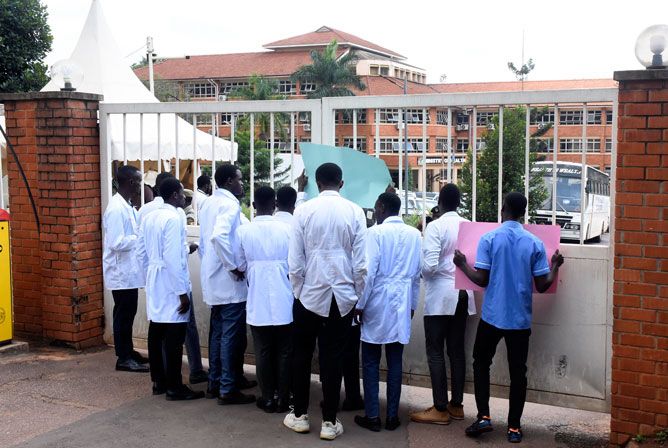
The Uganda Medical Association (UMA) has established a Technical Working Group (TWG) to review the controversial National Education and Training for Health Policy 2025 and assess its implications before finalising its position on the framework.
According to UMA Secretary General Dr. Alone Nahabwe, the team has been tasked with conducting a comprehensive analysis of the policy and submitting recommendations to the association’s National Executive Committee (NEC), which will guide an evidence-based decision.
The review team is chaired by Dr. Epuwatt, head of UMA’s Strategy, Policy Advisory and Research Committee (SPARC), and is supported by the association’s legal advisor. Former UMA President Dr. Ekwaro Obuku is also among the members of the team.
“A small Technical Working Group, chaired by Dr. Epuwatt, Chair of the Strategy, Policy Advisory and Research Committee (SPARC), and supported by our Legal Advisor, is currently reviewing the policy and its implications,” Dr. Nahabwe said.
He added that the group’s findings will inform the association’s final position, while other members with relevant expertise have been invited to contribute to the review process.
Despite initiating the review, UMA maintained its firm opposition to the policy in its current form.
“Our position remains as communicated during our last press conference: U.M.A rejects the proposed policy in its current form. The recommendations we made at that presser still stand,” Dr. Nahabwe said.
The association further reaffirmed its support for pre-intern doctors and other stakeholders calling for amendments, insisting that any reforms must protect training quality and patient safety.
“U.M.A supports all efforts by pre-interns and other stakeholders advocating for a comprehensive overhaul of the policy to protect training quality and patient safety,” he added.
The National Education and Training for Health Policy 2025, jointly launched by the Ministry of Education and Sports and the Ministry of Health in April, is intended to improve the quality, relevance, and standards of health professional training in Uganda.
However, the policy has sparked widespread debate within the medical fraternity due to proposals requiring medical students to complete a one-year supervised internship before graduation, effectively extending medical training from five to six years.
It also proposes changes to internship arrangements, including the reduction or removal of internship allowances.
Medical professionals and pre-intern doctors argue that internship has traditionally been a post-graduation licensing requirement rather than part of an academic degree programme.
They further contend that the proposed reforms could place financial strain on students, particularly those from disadvantaged backgrounds, while raising concerns about training quality, patient safety, trainee burnout, and the potential increase in health worker migration.
